
Formula 1 development is a race against restrictions. Teams want more aerodynamic downforce, less drag and a car that behaves predictably across 24 or more circuits, but the technical regulations cap how much wind tunnel and computational fluid dynamics (CFD) work they can do. The result is a constant search for efficiency: getting the most useful data from every permitted run.
What Wind Tunnels and CFD Actually Do
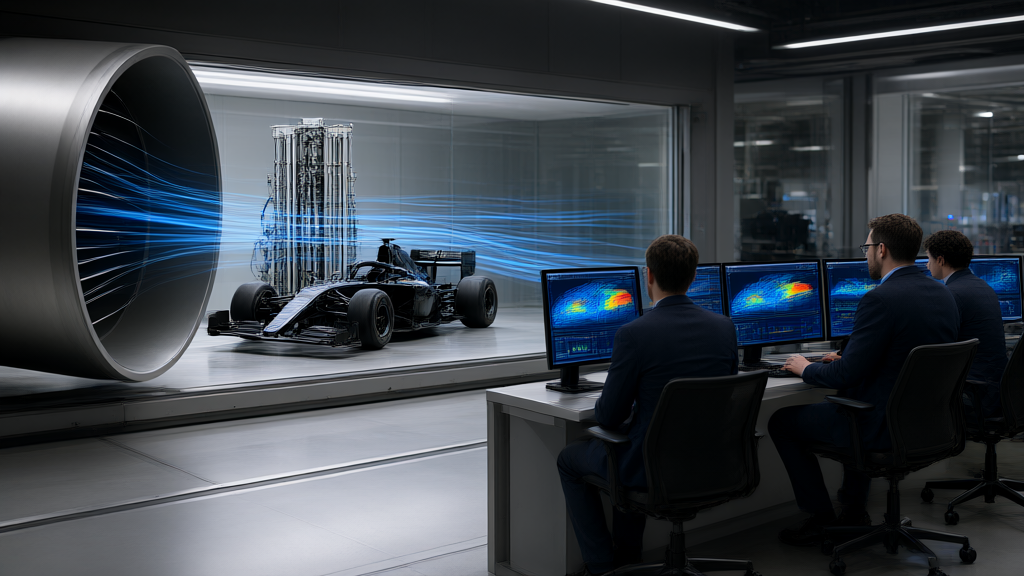
A wind tunnel pushes air over a scale model of the car while sensors measure forces. Engineers change a wing flap, a floor edge or a cooling outlet, then compare the numbers. CFD does something similar in software: it divides the airflow into millions of small cells and solves equations for velocity, pressure and turbulence. Both tools estimate how the real car will behave before any part reaches the track.
The two methods are complementary. Wind tunnels provide physical measurements, but they are expensive to run and limited by model scale and tunnel conditions. CFD can test ideas overnight without occupying a physical facility, but it depends on modelling assumptions. Teams cross-check one against the other, and against track data, because no single tool is trusted in isolation.
Why the Regulations Shape the Workflow
The FIA Formula 1 Technical Regulations and the associated sporting and financial rules restrict aerodynamic testing. Under the Aerodynamic Testing Restrictions (ATR), teams are allocated a limited number of wind tunnel runs and CFD compute hours, and the allowance is adjusted by championship position. Teams lower in the constructors’ standings receive more testing capacity than the leaders, a deliberate attempt to close the field.
The rules also specify how testing may be conducted. Wind tunnel model scale, tunnel speed and the number of runs per session are controlled, and teams must declare their aerodynamic testing activities. CFD is limited by a defined metric that converts processing power into a permitted allowance. These constraints mean engineers cannot simply brute-force every idea. They must prioritise the concepts most likely to deliver lap time.
Regulation changes add another layer. When the technical regulations shift, as they did for the 2022 ground-effect cars, the aerodynamic targets change with them. Teams must redirect wind tunnel and CFD resources toward understanding a new floor concept or a revised wing specification, often before they have reliable track data.
How a Development Loop Works
A typical aerodynamic development loop starts with a performance target. Engineers might want to recover downforce lost after a regulation clarification, or reduce drag on a low-downforce circuit. CFD is often used first because it is quick to set up and can screen many geometries. Promising concepts move to the wind tunnel for physical validation.
In the tunnel, the team measures forces and pressures on the model. If a new floor edge produces a gain in simulation but not in the tunnel, the discrepancy itself is useful information. It may point to a modelling error, a tunnel condition that does not match the track, or an interaction the simulation missed. Engineers then refine the concept or discard it.
Only after tunnel correlation is acceptable does a part usually reach the track. Even then, the track is the final judge. Real asphalt, tyre behaviour, ride height changes and yaw angles differ from any controlled test. A part that looks good in the tunnel can behave differently once the car is running in traffic or over kerbs.
Track Testing as the Validation Layer
Track testing validates the simulation chain. Teams compare measured car data, such as speed traces, ride heights and aerodynamic pressures, with what the wind tunnel and CFD predicted. If the correlation is strong, engineers gain confidence in the tools and can push development further. If it is weak, they investigate why.
Free practice sessions are the main opportunity for this validation because in-season testing is heavily restricted. Teams run aero rakes, which are arrays of pressure sensors mounted behind the front wheels, and other instrumentation to map airflow. The data helps them decide whether a new package stays on the car for qualifying and the race.
This is also where opinion and evidence separate. A team may say a new floor is a clear step forward, but the public evidence is usually limited to lap times and driver comments. Lap time gains can be masked by tyre compounds, fuel loads, track evolution and driving style. Without access to the team’s internal correlation data, outside observers should treat claimed aerodynamic gains as provisional.
The Trade-Offs Engineers Manage
Aerodynamic development is not just about adding downforce. More downforce often means more drag, which hurts straight-line speed. Teams balance the two depending on the circuit. A Monaco setup prioritises downforce; a Monza setup prioritises low drag. Wind tunnel and CFD work must therefore cover a range of configurations, not a single optimum.
Cooling is another constraint. Engines and brakes need airflow, but cooling outlets create drag. Engineers use CFD to model cooling flows and wind tunnels to test outlet designs. The goal is the smallest opening that keeps temperatures under control, which is a packaging problem as much as an aerodynamic one.
Mechanical balance also matters. Aero changes can shift the car’s balance, making it understeer or oversteer. Drivers may report that a car is faster in one corner but unpredictable in another. That feedback feeds back into the simulation loop, where engineers adjust the aerodynamic map rather than chasing a single peak number.
What This Means for Fans
When a team brings a new front wing or floor to a race, it is usually the visible end of a long process. Behind it are restricted wind tunnel runs, CFD simulations, correlation checks and track validation. The regulations make that process deliberately inefficient in the sense that teams cannot test endlessly, but they also reward organisations that prioritise well.
For fans, the practical takeaway is that aerodynamic development is a chain of estimates, not a single measurement. Wind tunnels and CFD are powerful, but they are tools for asking better questions. The track provides the answers, and even then, the answers are rarely as clean as a headline lap time suggests.
Conclusion
Formula 1 teams use wind tunnels and CFD to find lap time under strict regulatory limits. The two methods work together: CFD screens ideas quickly, wind tunnels provide physical validation, and track data confirms whether the simulation chain is trustworthy. The regulations cap how much testing is allowed, so success depends on prioritisation and correlation, not raw computing power alone. Fans should treat public claims of aerodynamic gains with caution unless they are supported by verifiable track evidence.