
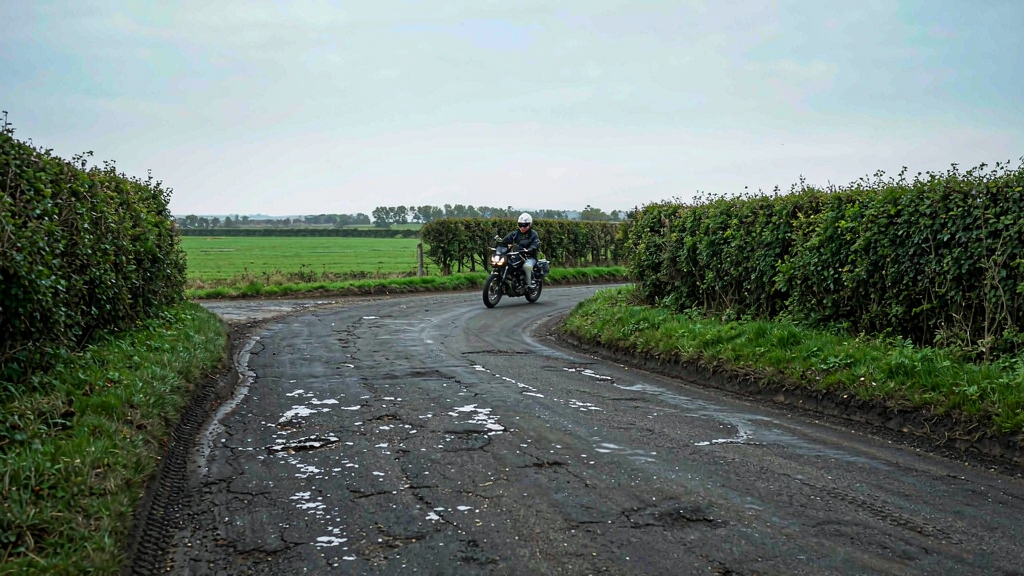
This article includes AI-generated illustrations, not documentary images.
Safety on a motorcycle route is not a single decision. It is a series of small ones: where you can see, where you can be seen, where other traffic might cross your path, and how long you can keep making good judgments. Sightlines, junctions and fatigue are the three factors that most often decide whether a ride stays routine or becomes an incident.
This article separates what road-safety research and rider training organisations consistently teach from what is reasonable rider judgment. Where evidence is limited or country-specific, that is stated rather than smoothed over.
Why sightlines come first
A sightline is the distance over which you can see the road ahead and identify a hazard before you need to act. On a motorcycle, that distance is also your braking and swerving budget. The UK Highway Code’s stopping-distance figures show how quickly speed consumes that budget: at 60 mph, typical stopping distance is around 73 metres on a dry road, and considerably more in the wet (GOV.UK, Typical stopping distances).
The practical rule is simple. Ride so that you can stop within the distance you can see to be clear. That is a training principle rather than a statistical finding, but it is consistent across recognised rider training bodies and is the foundation for everything that follows.
Hazard mapping a route before you ride
Hazard mapping means identifying, in advance, the places on a route where risk is concentrated. You do not need a formal risk assessment. A map, a satellite view and ten minutes of attention will do.
Look for these features and mark them:
- Blind bends and crests where the road disappears from view.
- Junctions, especially where a side road meets a faster road at an acute angle.
- Farm and field accesses, which often have poor visibility and slow-moving vehicles.
- Built-up areas where parked cars, pedestrians and driveways create multiple conflict points.
- Roadworks, temporary surfaces and known surface-change areas such as shaded or tree-lined sections.
The reason to do this is not to memorise every corner. It is to reduce surprise. A rider who expects a hidden junction approaches it with more margin than one who meets it at speed.
Junctions: where paths cross
Junctions are where two or more road users claim the same piece of tarmac. They are consistently over-represented in motorcycle casualty data. In the UK, the Department for Transport’s reported road casualty statistics show that junctions account for a large share of motorcycle collisions, particularly those involving another vehicle (Department for Transport, Road accidents and safety statistics).
The most common pattern is a vehicle emerging from a side road or turning across the rider’s path. The rider may have right of way, but right of way does not prevent a collision. Training organisations such as the Motorcycle Safety Foundation in the United States and the Royal Society for the Prevention of Accidents in the UK both emphasise scanning, positioning and speed control at junctions (Motorcycle Safety Foundation, msf-usa.org; RoSPA, rospa.com).
Practical measures at junctions include:
- Approach at a speed that lets you stop if a vehicle pulls out.
- Position for visibility, not for the shortest line.
- Make eye contact where possible, but do not treat it as a guarantee.
- Cover the brakes and be ready to adjust your line.
These are widely taught techniques. Their effectiveness is supported by training consensus rather than by controlled trials, and that distinction matters when you decide how much to rely on them.
Fatigue: the slow hazard
Fatigue is harder to map because it does not appear on a route. It builds quietly. Reaction time lengthens, attention narrows, and the rider may not notice the change until a near-miss.
Research on driver fatigue consistently links tiredness to slower reactions and increased crash risk. The UK’s Think! campaign and the National Highway Traffic Safety Administration in the US both warn that fatigue impairs driving in ways similar to alcohol, and that the only reliable remedy is rest (Think!, think.gov.uk; NHTSA, Drowsy driving).
For riders, the risk is compounded. Motorcycling demands balance, coordination and constant observation. A tired rider is not just slower to react; they are more likely to make small errors that a motorcycle does not forgive.
Rest planning: treat it as part of the route
Rest planning means deciding where and when you will stop before you set off. It is not a sign of weakness or inexperience. It is a way of protecting the quality of your riding.
A workable approach:
- Plan a stop at least every 90 to 120 minutes, or sooner if you feel tired.
- Choose stops with food, water and somewhere to walk around.
- Avoid heavy meals before a long stretch of riding.
- Build in a longer break in the middle of the day, when fatigue often peaks.
- If you feel drowsy, stop. Caffeine and cold air are temporary; sleep is the fix.
The 90-to-120-minute figure is a common planning guideline rather than a universal rule. Individual tolerance varies with fitness, weather, medication and sleep. The principle is to stop before you need to, not after.
Bringing it together
Sightlines, junctions and fatigue are connected. Poor sightlines reduce your time to react. Junctions create the situations where that time matters most. Fatigue erodes your ability to use whatever time you have.
A safe route plan addresses all three. Map the hazards. Approach junctions with margin. Plan rest before the ride, not during it. None of this guarantees a trouble-free ride, but it shifts the odds in your favour.
The evidence base for motorcycle safety is strongest on junction risk and fatigue impairment. It is weaker on the precise effectiveness of individual riding techniques. Treat training guidance as a strong starting point, and treat your own attention as the final check.